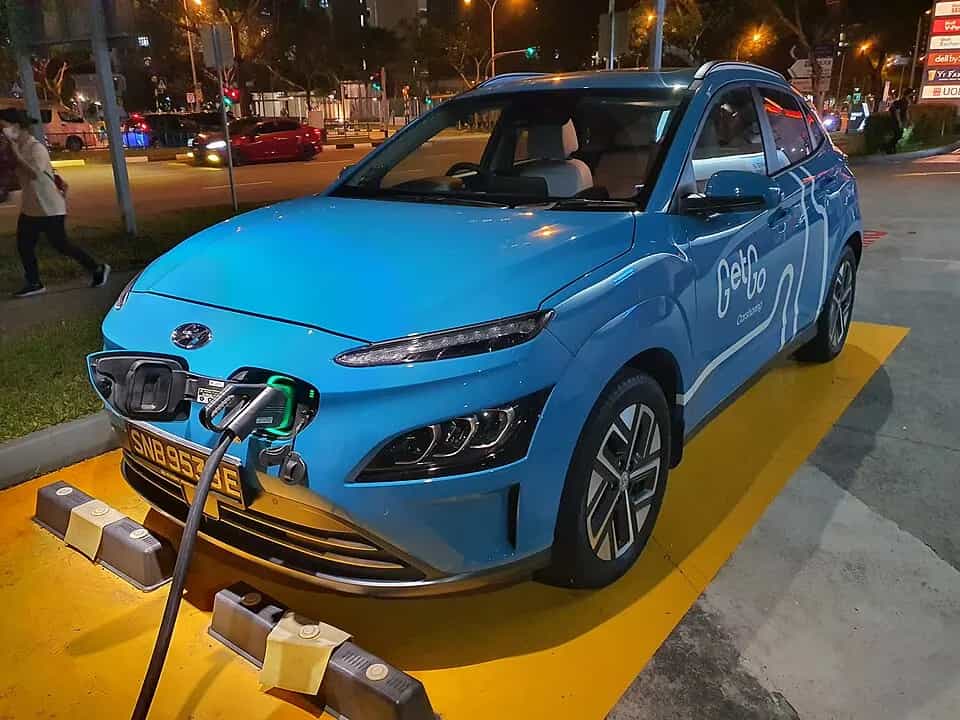
Hyundai Kona EV
Importing a used Hyundai Kona EV from the USA
The Hyundai Kona Electric earned a loyal following in North America as one of the first affordable long-range EVs, and a healthy stock of used examples now trickles onto the American market. As a broker, USCar Trader helps German and EU buyers source a used Kona EV in the States, verify its history, and bring it home under the current import rules. This page walks through what the Kona Electric actually is, how the US cars differ, and what to weigh before you commit to an import a used Kona EV from the USA project.

Production years and key changes
The first-generation Kona Electric (internal code OS) reached US showrooms as a 2019 model, sold as the "Kona Electric." Unlike the later dedicated E-GMP cars, it rides on a converted combustion platform, so it keeps a compact footprint and a conventional 400-volt architecture. Two batteries were offered globally, but the US market received almost exclusively the 64 kWh long-range pack. Hyundai gave it a facelift for 2022 with a closed-off nose and revised lighting. The second generation (SX2), launched for 2024, is noticeably larger and roomier, with a standard 48.6 kWh battery and a 64.8 kWh long-range option, plus faster onboard charging and a fresh cabin. When you shop US inventory today, most cars are first-generation 2019–2023 models.
What is under the hood
Every Kona Electric is front-wheel drive with a single permanent-magnet synchronous motor. The 64 kWh first-gen car makes 150 kW (201 hp) and 395 Nm, good for roughly 258 miles of EPA range and a 0–60 mph time near 6.4 seconds. Energy goes through a single-speed reduction gear. DC fast charging peaks around 75–77 kW on the first generation via a CCS Combo 1 inlet, while the second generation lifts peak charging to roughly 100 kW. A heat pump was optional on higher trims and is worth seeking out for winter efficiency. There is no AWD variant, which keeps the drivetrain simple and, generally, dependable.
Trims and body styles
The Kona Electric is a five-door subcompact crossover only; there is no coupe or convertible. US trims evolved over the run — SEL, Limited and Ultimate on the first generation, then SE, SEL and Limited on the second. Limited and Ultimate cars typically add leather, a sunroof, ventilated seats, a head-up display and the heat pump. Because the electric model shares its body with the combustion Kona, cabin space and cargo volume are modest but usable for a couple or small family.
What the US market offers
Used Kona Electrics are most common in the ZEV states — California, Oregon, Washington and the Northeast — where they sold in the largest numbers. Typical cars are 2019–2022 models with 30,000 to 80,000 miles. Condition is usually good; these are commuter EVs rather than abused ones, and the battery has aged well in most climates. A key selling point for used buyers is that many cars received a brand-new battery pack under the recall campaign described below, which can effectively reset the most expensive component.
Who this import is for
A used Kona EV import suits a buyer who wants a proven, right-sized electric crossover with real range and low running costs, and who values Hyundai's long powertrain warranty history. It is less suited to those needing all-wheel drive, ultra-fast charging or three-row space. If you want a simple, efficient daily EV and are comfortable with the CCS and lighting conversion work, the Kona Electric is one of the easier US EVs to live with in Europe.
Technical data and figures
| Specification | Detail (first-gen 64 kWh) |
|---|---|
| Body style | 5-door subcompact crossover |
| Drivetrain | Front-wheel drive |
| Motor | Single PMSM, 150 kW (201 hp) |
| Torque | 395 Nm |
| Battery (usable) | ~64 kWh lithium-ion NMC |
| EPA range | ~258 miles (~415 km) |
| 0–60 mph | ~6.4 s |
| Top speed | ~104 mph (167 km/h) |
| DC fast charge (peak) | ~75–77 kW (CCS Combo 1) |
| AC onboard charger | 7.2 kW |
| Length | ~4,205 mm |
| Curb weight | ~1,685 kg |
| Seating | 5 |
| Production years (US) | 2019–present |
Reliability: trouble spots to check
Kona EV reliability is generally strong, but there is one headline issue. Early 2019–2020 cars with LG Energy Solution cells were subject to a worldwide recall over a rare risk of battery fire; Hyundai's fix ranged from a software/BMS update to a full pack replacement. When you evaluate a used Kona Electric, confirming that the recall was completed — ideally with a replaced pack — is the single most important check. Beyond that, owners report occasional 12-volt battery drain, minor infotainment glitches and charge-port door quirks. The 12V issue is cheap to address and well documented. Regular maintenance is light: brake fluid, cabin filter, coolant service for the battery loop, and tyres. There is no engine oil, timing belt or exhaust to worry about.
US vs. Europe differences
The most practical difference is the charging inlet: US cars use CCS Combo 1, while European infrastructure uses CCS Combo 2. This is resolved with the correct inlet or a certified adapter as part of the conversion. US cars also run amber rear turn signals and lack a rear fog lamp, both of which must be addressed for German registration. The instrument cluster reads in miles and the navigation/telematics may need adaptation. Mechanically the car is identical, which keeps the process straightforward.
How the import works
The path runs from vehicle selection, to a VIN and origin check, to a secured payment via escrow, then ocean freight to a European port (typically Bremerhaven), customs clearance on arrival, a TÜV individual inspection with any required modifications, and finally local registration. USCar Trader coordinates each stage as your intermediary; we do not hold a dealer margin.
Import duty, VAT and fees
In short: the 0% duty rate applies only with documented US origin (VIN/plant) – German import VAT of 19% is always due.
Because the Kona EV carries a "neutral" origin, the applicable EU import duty depends on the car's actual place of manufacture as shown by the VIN. Most Kona Electrics sold in the US were built in South Korea, in which case the standard passenger-car duty applies rather than 0%. The 0% rate under Regulations (EU) 2026/1455 and 2026/1461 applies only to vehicles with provable US origin, on direct transport, and is never guaranteed. Separately and in every case, the 19% German import VAT (Einfuhrumsatzsteuer) applies on the customs value. We state both charges transparently and add no margin.
From modifications to registration
Typical TÜV items are the rear fog lamp, amber-to-red rear lighting compliance, headlight aiming, and a check that the odometer and speedometer display metric units where required. EVs are otherwise well received at inspection. Documentation of the recall completion and battery state of health strengthens the file.
Pre-buy inspection points
- Decode the VIN to confirm build plant and exact battery size.
- Pull a Carfax or AutoCheck history for accidents and title branding.
- Verify the battery-fire recall was completed and whether the pack was replaced.
- Request a battery state-of-health readout.
- Confirm a clean, non-salvage title.
- Inspect for underbody corrosion, especially on Northeast cars.
- Check service records and tyre age.
What buyers ask most
Is the Hyundai Kona EV a good import from the USA?
Yes, for a right-sized, efficient daily EV it is one of the more sensible US imports, provided the battery recall is done and the charging and lighting are converted for Europe.
Does the used Kona EV qualify for 0% EU import duty?
Only if the specific car has provable US origin. Most US-market Kona Electrics were built in South Korea, so the standard duty usually applies; the 19% import VAT always applies.
What is the real range of a used Kona Electric?
The 64 kWh first generation is rated around 258 miles EPA; expect roughly 350–400 km in mixed real-world driving depending on climate and the heat pump.
How fast does the Kona EV charge?
The first generation peaks near 75 kW on DC, so a 10–80% top-up takes roughly 45–50 minutes; the second generation charges faster.
What are the most common Kona EV problems?
The early LG battery recall is the main one; otherwise 12V battery drain and minor infotainment issues are the usual complaints.
Will the CCS charging work in Germany?
After converting from CCS Combo 1 to CCS Combo 2, yes — the car charges on standard European DC and AC networks.
Does USCar Trader sell the Kona EV directly?
No. We are an independent broker for used US vehicles and arrange the purchase, transport and clearance on your behalf.
Ready to look at cars? Browse Hyundai in the Carhub, compare the related Hyundai IONIQ 5 and Hyundai IONIQ 6, or view current Kona EV listings.